



Jinan University Research Team Makes Breakthrough in Large-Area Fabrication of Perovskite Solar Cells
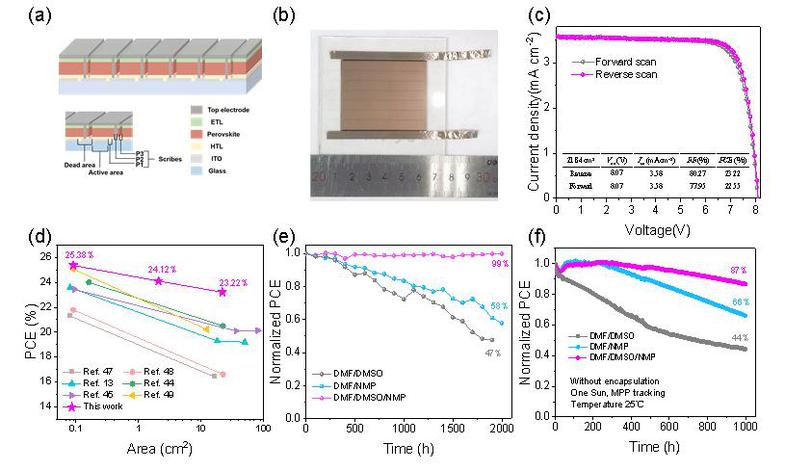
(Photovoltaic performance and stability of perovskite solar cells. Photo provided by the research team.)
November 3, 2025 – A research team led by Professor Mai Yaohua and Researcher Guo Fei from the New Energy Technology Research Institute, College of Physics and Optoelectronic Engineering at Jinan University, together with collaborators, has achieved a key advancement in the scalable fabrication of perovskite solar cells. By engineering the precursor solvent system, the team elucidated the critical mechanism of perovskite crystallization kinetics, offering a universal strategy for producing large-area, high-efficiency, and stable perovskite photovoltaic modules. The findings have been published in the internationally renowned journal Energy & Environmental Science.
Perovskite solar cells are considered a highly promising next-generation photovoltaic technology, owing to their low manufacturing cost and high-power conversion efficiency. While lab-scale small-area cells have reached efficiencies comparable to those of conventional silicon solar cells, upscaling them to large-area modules without compromising performance and stability remains a central challenge for commercialization. This is mainly due to the difficulty in controlling the crystallization process during large-area coating, which often leads to film defects and performance degradation.
In this study, the team modified the widely used DMF: DMSO solvent system by introducing a small amount of N-methyl-2-pyrrolidone (NMP). They demonstrated that this adjustment balances the “supersaturation rate” and “solvent coordination ability” during crystallization. The incorporation of NMP weakens the strong coordination between DMSO and lead iodide, facilitating rapid solvent dissociation in the precursor wet film and promoting the nucleation of the functional perovskite α-phase. Meanwhile, the high boiling point of NMP slows down the drying process, preventing disordered nucleation and solvent residue caused by an abrupt rise in supersaturation.
Using this crystallization-control approach, the team successfully produced high-quality perovskite films with high density, large grains, and low defect density. A small-area cell (0.09 cm²) fabricated from such a film achieved a power conversion efficiency of 25.38% with an open-circuit voltage as high as 1.19 V. In stability tests, the unencapsulated cell retained 87% of its initial efficiency after 1,000 hours of continuous operation in an inert atmosphere, demonstrating excellent operational durability.
To validate the scalability of the technique, the researchers collaborated with Guangdong Mailuo Energy Technology Co., Ltd. to fabricate a mini-module with an active area of 21.84 cm², which reached an efficiency of 23.22%. This result represents a leading performance among reported perovskite modules of similar size, significantly narrowing the efficiency gap between lab-scale cells and large-area devices.
This work not only provides scientific insight into how solvent coordination competition and supersaturation rate govern thin-film growth, but also outlines a practical technical pathway toward the mass production of perovskite photovoltaics.
NEWS
- About the University
- Quick Links

Copyright © 2016 Jinan University. All Rights Reserved.