



Jinan University Team Reports Breakthrough in Photocatalytic Cluster Design for Inert Molecule Activation
A research team from the College of Chemistry and Materials Science at Jinan University has published significant findings on photocatalytic materials in the internationally renowned journal Angewandte Chemie (German Journal of Applied Chemistry). The study, led by Professors Wu Tao, Yuan Shangfu, and Wang Bingzhe, was titled "High Reduction Potential and Efficient Charge Transfer Semiconductor Clusters for Visible Light Driven Inert Organic Substrate Activation." It presents a newly designed semiconductor cluster-based photocatalytic system that combines an extremely high reduction potential with efficient charge transfer under visible light, offering a novel strategy for activating and functionalizing inert organic molecules.
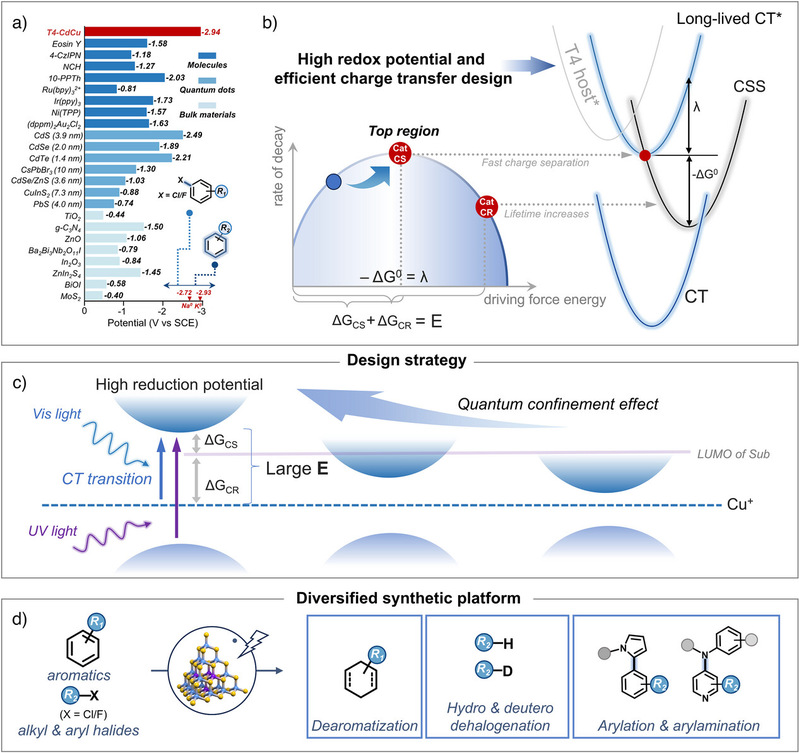
Photoredox catalysis serves as an important tool in organic synthesis, yet its advancement has been constrained by the challenge for photocatalysts to simultaneously achieve strong thermodynamic reducing power and efficient kinetic charge transfer in the visible light region. To address this, the team developed a T4 CdCu cluster catalyst based on metal chalcogenide supertetrahedral clusters. By employing quantum confinement effects for energy level modulation and a precise copper doping strategy (Figure 1c), the cluster exhibits a very high reduction potential of –2.94 V (vs. SCE) and achieves rapid charge separation alongside slow charge recombination kinetics—aligning with the ideal conditions for efficient charge transfer predicted by Marcus theory (Figure 1b).
The charge transfer mechanism of the clusters was systematically elucidated using femtosecond/nanosecond transient absorption spectroscopy, electrochemical analysis, and theoretical calculations. The introduction of Cu+ creates a visible-light-responsive charge transfer state that enables high-energy electron injection while maintaining fast electron separation and slow recombination under visible light excitation (Figure 1a, d). The catalyst demonstrated high activity and broad functional group compatibility across various transformations, including dearomatization of inert substrates, C–Cl/C–F bond reduction, arylation, and amination reactions (Figure 1d). Furthermore, the catalytic system was successfully applied to late-stage functionalization and deuterium labeling of drug molecules and was scaled up to gram-level flow-phase reactions, highlighting its potential for practical applications.
This work provides new insights into the design of high-performance photocatalysts and offers an important reference for understanding the balance between thermodynamics and kinetics in photocatalytic systems. The findings were published in Angew. Chem. Int. Ed., 2025 (DOI: 10.1002/anie.202509764). Ma Hao, Han Chengkun, and Liu Jiaxing are co-first authors, with Associate Professor Wang Bingzhe, Professor Yuan Shangfu, and Professor Wu Tao serving as corresponding authors.
Link to the paper: https://doi.org/10.1002/anie.202509764
Editor: Li Weimiao
NEWS
- About the University
- Quick Links

Copyright © 2016 Jinan University. All Rights Reserved.